Buying a used car?
Check for accidents & damage before you make a purchase.
Hidden damage is one of the biggest concerns when buying a used car as it can have lasting effects on a car's safety, performance and resale value. It’s often hard to tell if a car has been in an accident or damaged in some way.
A CARFAX Canada Vehicle History Report provides detailed third-party information on the reported accident and damage history of a vehicle, helping you:
Uncover events the seller may not have disclosed or been aware of
Negotiate a fair price
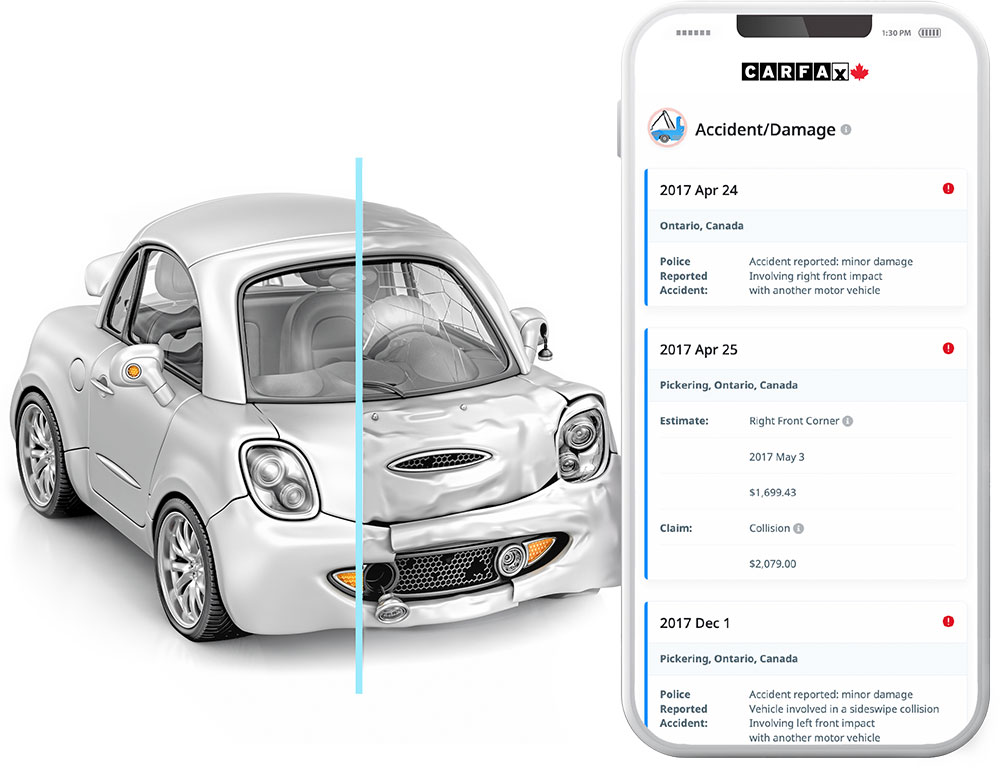
What accident & damage information can be found on a CARFAX Canada Vehicle History Report?
On a CARFAX Canada Vehicle History Report, you’ll find a comprehensive summary of available reported accidents and damage from thousands of sources across North America, including:
Police reports
Insurance estimates & claims
Collision repair records
Environmental damage (e.g., hail, flood)
Where data is available, the report will tell you:
The number of incidents
The dates they occurred
The point of impact
The dollar amount of the repairs
How does accident & damage history affect a vehicle’s value?
Accident and damage history has a direct impact on a used vehicle's market value. Whether you're buying, selling, or trading in, understanding this relationship can help you make a more informed decision.
Factor:
Severity of damage
Impact on vehicle value:
Minor cosmetic damage, like dents and scratches, could have less impact than serious damage, like structural or flood damage.
Factor:
Quality of repairs
Impact on vehicle value:
Quality repairs from a certified shop with documentation, could help your car hold a higher value than if the repairs were uncertified or undocumented.
Factor:
Number of incidents
Impact on vehicle value:
The more accidents a vehicle has had, the more the vehicle's value can go down
Factor:
Vehicle age & mileage
Impact on vehicle value:
Damage can have a bigger impact on what a newer, lower mileage car is worth compared to an older one.
Every CARFAX Canada Vehicle History Report comes with a free History-Based Value (HBV). This price estimate considers the vehicle's unique history, including any accidents and damage, to help you negotiate a fair price

Includes a Free History-Based Value!
What to consider when buying a car that's been in an accident.
Finding damage in a vehicle’s history doesn’t neccessarily mean you shouldn’t buy it. What matters most is having the full picture so you can make an informed decision.
To help you decide, ask yourself these questions:
How severe is the damage?
A CARFAX Canada Vehicle History Report can indicate the severity of reported damage. Look for red flags like airbag deployment, structural/frame damage, flood damage, or multiple reported incidents. Note that insurance estimate and claim amounts are only one indicator and may not fully reflect the nature of or extent of the damage.
Was it properly repaired?
Ask the seller for documentation of repairs, including receipts from a certified collision repair facility. A professional repair by a reputable shop is far better than a DIY fix.
Has a licensed mechanic inspected it?
Always get a pre-purchase inspection from a licensed mechanic before buying any used vehicle, especially one with accident history.
Does the price reflect the history?
A vehicle's accident and damage history is one of many factors that can affect its market value. We recommend using the free History-Based Value included in every CARFAX Canada Vehicle History Report to help you assess whether the asking price is reasonable.
The bottom line? A vehicle that’s been in an accident can still be a great buy if you have the facts to help you make an informed decision.
Frequently Asked Questions
-
As a buyer, you can't always rely on a seller to volunteer a vehicle's full history. That's why doing your own due diligence is important, especially when it comes to accidents and damage. To help yourself when buying used, we always recommend the following:
Take the car for a test drive
Get a CARFAX Canada Vehicle History Report
Get an independent pre-purchase inspection
Request documentation for any repairs that have been made
-
There are several things you can do to make sure you aren’t buying a flood-damaged used car:
Get the history: If flood damage has been reported, a CARFAX Canada Vehicle History Report will provide you with relevant information.
Smell for odours: It’s hard to get the smell of musty carpets and water-logged seat padding out of a car. If you detect an odour, this could be a good indication that stagnant water has sat in the car for a considerable amount of time.
Investigate the interior: Pull back the carpets to look for lingering mud, dirt and water stains. You should also check the trunk for water lines, leftover silt or rust.
Look for condensation: There could be moisture lingering in the instrument panels. Water can fry your vehicle’s accessories, so you’ll also want to test the dashboard lights, wipers, signal lights, radio, heater, air conditioner and any other switches or options to make sure they are in working order.
Get a pre-purchase inspection: Take your vehicle to a licensed mechanic for a thorough pre-purchase inspection. This inspection will determine the cosmetic, mechanical and safety condition of the car and can let you know if there is any water damage internally. While the car may seem perfect on the outside, saltwater or water damage can have lingering effects on the car’s braking, steering and electrical systems.
-
“Total loss” is an insurance term indicating that the cost to repair the vehicle is equal to or greater than its market value, and/or the vehicle’s structural integrity is severely compromised.
On a CARFAX Canada Vehicle History Report, the term “total loss” can appear on insurance claims in the Accident/Damage section.
Make sure to review the Registration section of the report to confirm the “branding” of the vehicle. Branding is applied by provincial transportation authorities to classify the condition of the vehicle. Vehicles with total loss insurance claims are often classified as “Salvage”, meaning the vehicle was written off but may be repaired and rebranded as "Rebuilt" upon passing a structural inspection , or "Non-repairable" (also referred to as "Irreparable" in some provinces), meaning the vehicle is too damaged to be safely repaired and can only be used for parts or scrap.
-
If there are no incidents listed in the Accident/Damage section of a CARFAX Canada Vehicle History Report, it means that there were no accident/damage records reported to CARFAX Canada at the time the report was purchased. There may be other information about the vehicle that has not been reported to CARFAX Canada and therefore will not appear on the CARFAX Canada Vehicle History Report.
When buying a used vehicle, we always recommend using a CARFAX Canada Vehicle History Report, along with a vehicle inspection and test drive, to make an informed decision.
